Of course! Self-studying for the CMA (Certified Management Accountant) exam in English is a challenging but very achievable goal. It requires significant discipline, but it's also incredibly rewarding.
Here is a comprehensive guide on how to self-study for the CMA in English, broken down into steps.
Phase 1: Before You Begin - The Foundation
Understand the CMA Exam
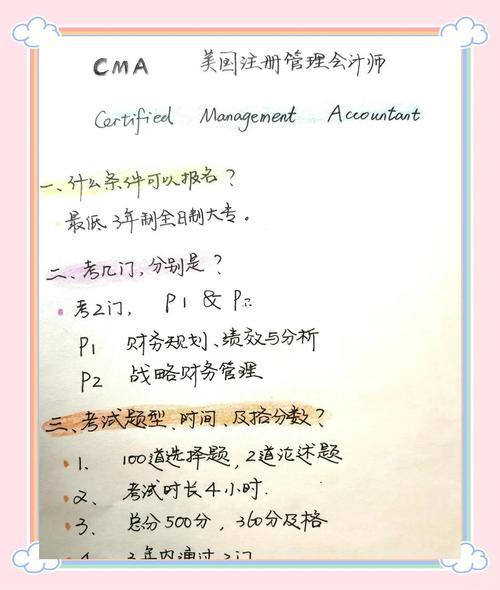
First, know what you're signing up for. The CMA has two parts:
-
Part 1: Financial Planning, Performance, and Analytics
- External Financial Reporting Decisions (15%)
- Planning, Budgeting, and Forecasting (20%)
- Performance Management (20%)
- Cost Management (15%)
- Internal Controls (15%)
- Technology and Analytics (15%)
-
Part 2: Strategic Financial Management
- Financial Statement Analysis (20%)
- Corporate Finance (20%)
- Decision Analysis (20%)
- Risk Management (10%)
- Investment Decisions (15%)
- Professional Ethics (15%)
Check Your Eligibility
Before you spend money on study materials, ensure you meet the IMA's (Institute of Management Accountants) requirements:
- Membership: Join the IMA.
- Education: A bachelor's degree from an accredited institution.
- Exam: Pass both parts of the CMA exam.
- Experience: At least two continuous years of professional experience in management accounting or financial management.
Create a Realistic Study Plan
This is the most critical step for self-study. A CMA candidate typically needs 300-400 hours of study time per part.
- Assess Your Schedule: How many hours can you commit per week? Be honest. 10-15 hours/week is a common target.
- Set a Timeline: A common timeline is 3-4 months per part. This means finishing one part before starting the next.
- Use a Planner: Google Calendar, a physical planner, or a project management tool like Trello can help you schedule your topics and mock exams.
- Buffer Time: Always add a 2-3 week buffer at the end for review and last-minute questions.
Sample 4-Month Plan for One Part:
- Month 1: Topics 1 & 2 (e.g., Planning, Budgeting & External Reporting)
- Month 2: Topics 3 & 4 (e.g., Performance Management & Cost Management)
- Month 3: Topics 5 & 6 (e.g., Internal Controls & Analytics)
- Month 4: Full review of all topics, taking multiple mock exams.
Phase 2: Choosing Your Study Materials
For self-study, you need high-quality, structured materials. Here are the top options, most of which are available in English.
Official CMA Review Providers (Highly Recommended)
These are all-in-one packages with video lectures, textbooks, practice questions, and mock exams. They are the most popular and effective choice for self-learners.
-
Wiley CMAexcel:
- Pros: Very comprehensive, excellent practice questions, good analytics to track your progress. The "Test Bank" is legendary. Strong focus on both concepts and exam technique.
- Cons: Can be a bit dry for some learners.
-
Gleim CMA Review:
- Pros: Known for its massive question bank. If you learn by doing thousands of questions, this is for you. The system is very structured and methodical.
- Cons: The video lectures are sometimes considered less engaging compared to others.
-
Becker CPA Review (now Surgent):
- Pros: Surgent has a very modern platform with adaptive learning technology that focuses on your weak areas. Their content is concise and to the point.
- Cons: The question bank, while good, is not as vast as Gleim's.
-
Hock International:
- Pros: A more affordable option. Known for its straightforward, no-frills approach and excellent, high-quality practice questions.
- Cons: The presentation might feel less polished than the big names.
Recommendation: Wiley CMAexcel or Surgent are fantastic all-round choices for most self-studiers. If you are weak in a specific area, Gleim is excellent for drilling questions.
Supplemental Resources
These are free or low-cost tools to use alongside your main course.
- IMA Learning Center: Your IMA membership gives you access to a library of articles, webinars, and the official CMA exam prep materials. This is a must-use resource.
- YouTube Channels:
- CMA Exam Academy: Offers free video lessons on specific topics.
- Farhat's Accounting Lectures: Great for breaking down complex accounting concepts.
- Professor Ofella: Another excellent channel for clear explanations.
- CMA Discussion Forums: The CMA subreddit (r/CMA) and the IMA's own forums are invaluable. You can ask questions, find study buddies, and get motivation from others going through the same process.
- Anki or Quizlet: Create digital flashcards for key formulas, definitions, and concepts. Spaced repetition is a powerful memory tool.
Phase 3: The Study Strategy - How to Study
The Learning Loop (For Each Topic)
Don't just read a chapter and move on. Follow this cycle:
- Preview: Skim the textbook chapter or watch the introductory video to get an idea of the key concepts.
- Learn: Actively study the material. Take notes, write down formulas, and try to understand the "why" behind the concepts, not just the "what."
- Practice: Do the practice questions immediately after studying the topic. Don't wait until the end of the chapter.
- Review: When you get a question wrong, don't just read the explanation. Find the exact line in the textbook that explains the concept and mark it. Understand why your answer was wrong.
- Repeat: Move to the next sub-topic and repeat the process.
Focus on Key Areas
Some topics are more heavily tested than others. Pay special attention to:
- Variances (Price, Quantity, Mix, Yield)
- NPV, IRR, Payback Period
- Transfer Pricing
- Variance Analysis & Behavioral Aspects
- Risk & Return
- Ethics (This is crucial and tested in both parts!)
Master the MCQs (Multiple Choice Questions)
The CMA exam is 50% MCQs and 50% essay questions. MCQs are your foundation.
- Quality over Quantity: It's better to understand 100 questions deeply than to rush through 500.
- Simulate Exam Conditions: As your exam date approaches, start doing sets of 100 MCQs in a timed block (e.g., 3 hours).
- Analyze Every Question: Understand why the correct answer is right and why the wrong answers are wrong. The distractors (wrong answers) are designed to test common misconceptions.
Tackle the Essay Questions (Written Communications)
This is what often trips up self-studiers.
- Structure is Key: Your answer needs a clear structure. Use bullet points, headings, and indentations. The graders look for organized, easy-to-read answers.
- The A-R-C Model (Answer, Reason, Calculation):
- Answer: State your conclusion directly at the beginning. (e.g., "The company should accept the project.")
- Reason: Provide the supporting reasons and calculations. (e.g., "This is because the NPV is positive $50,000...")
- Calculation: Show your work. Even if you get the final number wrong, you can get partial credit for showing the correct formula and steps.
- Practice Writing: You must write out full answers. Don't just think them. Use the practice essay questions in your review course and time yourself (30 minutes per question).
Phase 4: Exam Registration and Scheduling
- Register with IMA: Ensure your membership is active.
- Apply for the Exam: Log in to your IMA account and apply for the CMA exam. You will receive an Authorization to Test (ATT).
- Schedule with Prometric: Your ATT is valid for 6 months. You must schedule your exam with Prometric within this window. Book your exam date as soon as you have your ATT to lock it in.
Phase 5: Final Preparation
- The Last 2 Weeks: Stop learning new material. Focus on review.
- Full-Length Mock Exams: Take at least 3-4 full, timed mock exams under exam conditions (no notes, no distractions).
- Review Your Weaknesses: Go back to the questions you got wrong and focus on those topics.
- Memorize Key Formulas: Create a "cheat sheet" of all the essential formulas and review it daily.
- Rest: The night before the exam, get a good night's sleep. Don't cram.
Final Words of Encouragement
Self-studying for the CMA is a marathon, not a sprint. It will be difficult, and there will be days you feel like giving up. But remember:
- Consistency is more important than intensity. 1 hour every day is better than 7 hours on a Sunday.
- It's a process. You will learn and grow with every topic.
- You are not alone. Use the forums and communities to stay motivated.
Good luck! You can do this.