Of course. Here is a comprehensive overview of opinions on online courses, structured with different viewpoints, key vocabulary, and example sentences. This can be used for an essay, a presentation, or a general discussion.
A Comprehensive View on Online Courses (网络课程的看法)
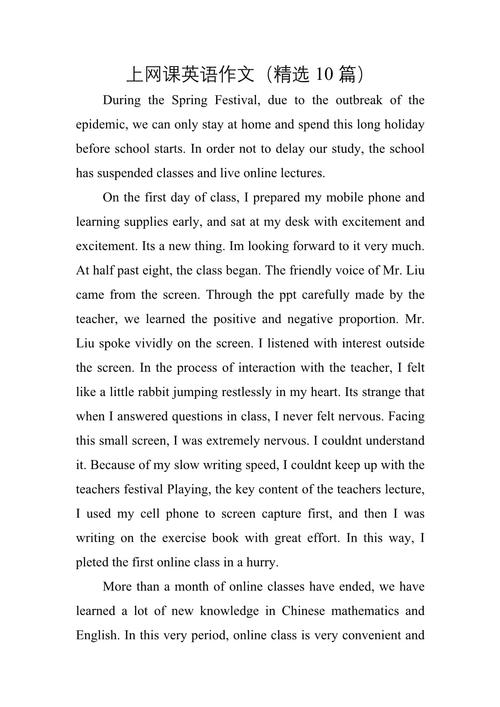
Online courses have fundamentally reshaped the landscape of education, offering unprecedented flexibility and accessibility. However, they are not without their challenges. The perception of online learning is multifaceted, with strong arguments for both its advantages and disadvantages.
Here’s a breakdown of the common perspectives:
I. The Advantages / Positive Views (优势/正面看法)
Proponents of online courses highlight several key benefits that make them a powerful tool for modern education.
Unmatched Flexibility and Convenience (无与伦比的灵活性与便利性) This is often the most cited advantage. Students can access course materials and lectures from anywhere in the world, at any time.
- Key Phrases:
- "Learn at your own pace."
- "Fit education around a busy schedule."
- "Eliminate the need for commuting."
- Example Sentence: "The greatest appeal of online courses is their flexibility; a working professional can pursue a degree or learn a new skill without having to quit their job or relocate."
Accessibility and Affordability (可及性与经济性) Online courses break down geographical and financial barriers.
- Key Phrases:
- "Democratize education."
- "A wider range of courses is available."
- "Often more cost-effective than traditional education." (due to lower overhead costs)
- Example Sentence: "Online platforms provide access to world-class instructors and Ivy League courses to anyone with an internet connection, truly democratizing education."
Diverse Learning Resources (多样化的学习资源) Digital learning environments are rich with various types of content that cater to different learning styles.
- Key Phrases:
- "Multimedia content (videos, podcasts, interactive quizzes)."
- "A vast repository of information."
- "Self-paced learning modules."
- Example Sentence: "Instead of just listening to a lecture, students can engage with interactive simulations, watch video demonstrations, and participate in online forums, which caters to diverse learning preferences."
Development of Self-Discipline and Digital Literacy (培养自律性与数字素养) Online learning requires a high level of personal responsibility and equips students with valuable digital skills.
- Key Phrases:
- "Fosters independent learning skills."
- "Builds time management abilities."
- "Enhances digital literacy."
- Example Sentence: "Succeeding in an online course requires significant self-motivation and discipline, skills that are highly transferable to any professional career."
II. The Disadvantages / Negative Views (劣势/负面看法)
Critics of online courses point out several significant drawbacks that can hinder the learning experience.
Lack of Face-to-Face Interaction and Socialization (缺乏面对面交流与社交) The absence of physical classrooms can lead to feelings of isolation and a lack of immediate feedback.
- Key Phrases:
- "Feelings of isolation and disconnection."
- "Limited non-verbal communication."
- "Difficulty in building a sense of community."
- Example Sentence: "One major drawback is the lack of spontaneous interaction with peers and instructors, which can make learning feel lonely and impersonal."
Requirement for High Self-Motivation and Time Management (需要高度的自律性与时间管理能力) The freedom of online learning can be a double-edged sword. Without a structured environment, many students struggle to stay on track.
- Key Phrases:
- "Prone to procrastination."
- "Lack of external structure and accountability."
- "Difficulty staying motivated without direct supervision."
- Example Sentence: "For individuals who are not highly self-disciplined, the freedom of online learning can quickly lead to falling behind and failing to complete the course."
Potential for Distractions and Technical Issues (潜在的干扰与技术问题) Home environments are often filled with distractions, and technical difficulties can disrupt the learning process.
- Key Phrases:
- "Vulnerable to home environment distractions."
- "Dependence on stable technology and internet access."
- "Technical glitches can be frustrating."
- Example Sentence: "Poor internet connectivity or a noisy home environment can severely impact the quality of an online lecture, creating a frustrating experience for both students and teachers."
Questionable Quality and Credibility (质量与可信度的质疑) Not all online courses are created equal. There are concerns about the depth of instruction, the credibility of the issuing institution, and the ease of cheating.
- Key Phrases:
- "Varying quality of instruction."
- "Diploma mills and unaccredited programs."
- "Challenges in assessing authentic student work."
- Example Sentence: "The sheer number of online courses available makes it difficult for learners to distinguish between high-quality, accredited programs and those that offer little real value."
III. Balanced View / The Future of Online Learning (平衡的看法/在线学习的未来)
A more nuanced perspective recognizes that online courses are not a replacement for traditional education but rather a powerful supplement. The future likely lies in a blended or hybrid approach.
- Hybrid Learning (混合式学习): This model combines the best of both worlds—online flexibility for lectures and self-study with in-person sessions for labs, discussions, and group projects. This approach can foster both independence and community.
- Complementary Tool (补充工具): For many, online courses are an excellent way to:
- Upskill or reskill without a major time commitment.
- Explore a new interest before committing to a full degree program.
- Access specialized knowledge that may not be available locally.
Conclusion:
Online courses are a transformative force in education. While they offer incredible flexibility and access, they also demand a high degree of self-discipline and cannot fully replicate the social and interactive dynamics of a traditional classroom. Their ultimate value is not in replacing face-to-face learning but in expanding the possibilities of education, making it more accessible, diverse, and adaptable to the needs of the 21st-century learner. The most effective educational model of the future will likely be one thoughtfully blends online and offline elements.