Of course. Here is a detailed breakdown of the advantages and challenges of self-study, presented in English with key vocabulary highlighted.
The Advantages and Challenges of Self-Study
Self-study, or independent learning, is the process of acquiring knowledge or skills on your own, without formal instruction from a teacher. In today's digital age, it has become more accessible than ever. However, it comes with a unique set of benefits and obstacles.
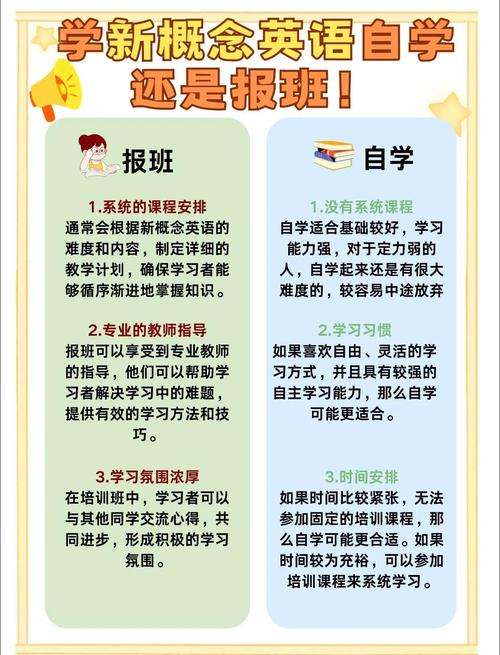
Part 1: The Advantages of Self-Study (优点)
Self-study offers a range of powerful benefits that can make learning more effective, flexible, and personally rewarding.
Flexibility and Convenience (灵活性与便利性)
This is often the most significant advantage. You are not bound by a fixed schedule or location.
- Learn at your own pace: You can spend more time on difficult concepts and breeze through what you already know.
- Learn anywhere, anytime: Whether it's on your commute, during a lunch break, or late at night, you can learn whenever and wherever it suits you.
- Customize your schedule: You can fit learning around your job, family, and other commitments.
Personalization and Customization (个性化与定制化)
You have complete control over what, how, and when you learn.
- Choose your own curriculum: You can focus specifically on what you need or are passionate about, rather than following a standardized syllabus.
- Select your resources: You can choose the learning materials that work best for you, whether it's video tutorials, online courses, podcasts, books, or interactive apps.
- Tailor to your learning style: If you're a visual learner, you can focus on diagrams and videos. If you learn by doing, you can find more hands-on projects.
Development of Self-Discipline and Responsibility (自律性与责任感的培养)
Self-study is an excellent way to build crucial life skills.
- Builds self-motivation: Without a teacher to push you, you must learn to motivate yourself to start and continue your studies.
- Enhances time management: You have to plan your study sessions and stick to them, which is a valuable skill in any career.
- Fosters independence: You learn to rely on your own ability to find information, solve problems, and take responsibility for your own progress.
Cost-Effectiveness (成本效益)
Self-study can be significantly cheaper than traditional education.
- Free or low-cost resources: The internet is filled with high-quality free content like MOOCs (Massive Open Online Courses), YouTube channels, and educational blogs.
- No extra fees: You save on tuition, commuting costs, accommodation, and other associated expenses of formal schooling.
Deeper and More Lasting Learning (更深入、更持久的学习)
When you learn on your own, you often engage with the material more deeply.
- Active learning: You are actively searching for information, connecting ideas, and solving problems, rather than passively receiving information in a lecture.
- Builds critical thinking: You learn to evaluate sources, question information, and think for yourself.
- Creates a sense of achievement: Successfully mastering a skill through your own efforts provides a powerful sense of accomplishment and boosts your confidence.
Part 2: The Challenges of Self-Study (困难)
While self-study is rewarding, it is not without its difficulties. Success requires overcoming several common hurdles.
Lack of Structure and Guidance (缺乏结构与指导)
Without a formal curriculum or a teacher, it's easy to feel lost.
- No clear roadmap: It can be difficult to know where to start, what to learn next, or which resources are the most reliable.
- No expert to ask questions: When you're stuck, you don't have a teacher to provide immediate clarification or feedback. You have to find the answer yourself, which can be frustrating and time-consuming.
Requirement for High Self-Discipline (需要高度的自律)
The freedom of self-study is a double-edged sword.
- Procrastination: It's easy to put off studying when there's no one holding you accountable.
- Distractions: The very devices and platforms you use to learn (social media, news, etc.) are full of distractions.
- Lack of motivation: On days when you feel unmotivated or tired, it can be very difficult to push yourself to study.
Limited Feedback and Interaction (反馈与互动有限)
Learning is a social process, and self-study can be isolating.
- No feedback on performance: You might not know if you are making mistakes or if your understanding is correct until much later, when you apply the knowledge.
- Lack of peer interaction: You miss out on the benefits of group discussions, brainstorming with classmates, and learning from others' perspectives and questions.
- Feeling of isolation: Studying alone can sometimes feel lonely and demotivating.
Potential for Information Overload (信息过载的风险)
The abundance of information can be as much a curse as a blessing.
- Too many choices: With countless resources available, it can be overwhelming to decide which ones to use, leading to "analysis paralysis."
- Quality control: Not all online information is accurate or up-to-date. It takes effort to distinguish credible sources from unreliable ones.
Time-Consuming (耗时)
Finding and organizing high-quality learning materials requires a significant investment of time and effort that you wouldn't have to make in a traditional classroom setting.
Conclusion (
Self-study is a powerful tool for personal and professional growth. Its flexibility, cost-effectiveness, and ability to foster independence make it an attractive option for many. However, these advantages are counterbalanced by significant challenges, including the need for immense self-discipline, the lack of structure and feedback, and the potential for feeling isolated.
Ultimately, the success of self-study depends heavily on the individual's motivation, organizational skills, and ability to create a supportive learning environment for themselves.